Intruder Alarms – A Practical Guide
A calm, practical guide to understanding intruder alarms, how they work, and how to choose the right system for your home.
Quick Start: The Five Decisions That Matter Most
- Decide what you need to protect.
Focus on specific risks—such as a rear door, a side passage or a garage—rather than trying to alarm every possible space. - Choose dependable power and signalling. Wired systems offer long-term reliability; mains-powered wireless systems are easier to install; battery sensors trade convenience for maintenance.
- Prioritise detection and response over features. Reliable door and window sensors, a clear internal siren and fast alerts usually matter more than advanced automation or app extras.
- Plan monitoring and notifications. Decide whether you want local alerts only, shared household notifications or a professional monitoring service—and understand any ongoing cost
- Reduce false alarms and respect household routines. Use sensible sensor placement, entry/exit delays and modes that fit daily life. Avoid placing sensors where pets, draughts or loose items can trigger them.
Simple rule: choose the simplest alarm system that reliably detects entry, alerts the right people and fits the way your household actually lives.
What is An Intruder Alarm
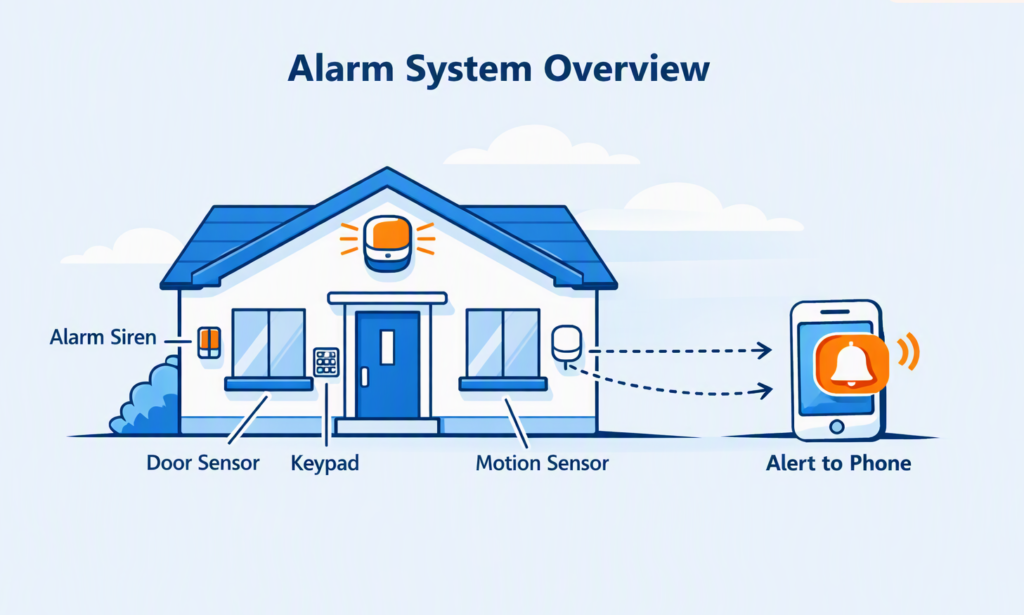
An intruder alarm is a system of sensors, a control unit and a siren designed to warn you when someone may be entering your home without permission. Sensors can detect a door or window opening, movement inside the property or, in some systems, an attempt to force an entry point.
When a sensor is triggered while the alarm is set, the system may sound a siren, send an alert to your phone, contact nominated people or notify a monitoring centre. The alarm does not replace strong locks and sensible habits, but it adds an important warning layer.
Why Intruder Alarms Matter
A good alarm can provide early detection, giving you and others more time to react. A visible external sounder may also discourage an opportunistic intruder from choosing the property.
- Deterrence: visible equipment can make a home appear less attractive to a casual offender.
- Peace of mind: alerts can reassure you when you are asleep, at work or away.
- Reduced impact: a quick warning may shorten the time an intruder remains in the home.
- Layered security: alarms work best alongside reliable locks, secure doors and windows, lighting and good everyday routines.
No alarm can guarantee that a break-in will not happen. Its value is in making entry harder to ignore and helping you respond sooner.
Types of Intruder Alarms
Passive Alarms (Audible-only)
An audible-only alarm sounds a siren inside, outside or both. It relies on people nearby noticing the alarm; it does not normally contact a monitoring centre.
- Lower purchase and running costs
- Relatively simple to install and use
- Suited to smaller homes or lower-risk situations
- Less reassuring if the home is isolated or neighbours are unlikely to respond
Active Alarms (Monitored Systems)
A monitored system sends a signal outside the home when activated. Depending on the service, alerts may go to you, nominated contacts or a professional monitoring centre. Some services can arrange a response under agreed procedures, but this is not automatically the same as a police response.
- Useful when a home is often empty
- Offers greater reassurance and support
- Usually involves installation, subscription or contract costs
- Response arrangements should be checked carefully before purchase
Smart Alarms
Smart alarms use an app for setting, unsetting and receiving notifications. Many can work with compatible cameras or video doorbells and are suitable for flexible or DIY installations.
- Convenient remote control and alerts
- Easy to expand in many cases
- May depend on broadband, Wi-Fi, mobile service or cloud services
- Quality, support and privacy protections vary between brands
Each type of alarm relies on sensors to detect movement or entry. Understanding the main sensor types will help you choose a system that suits your home.
Types of Sensors (and What They Do)
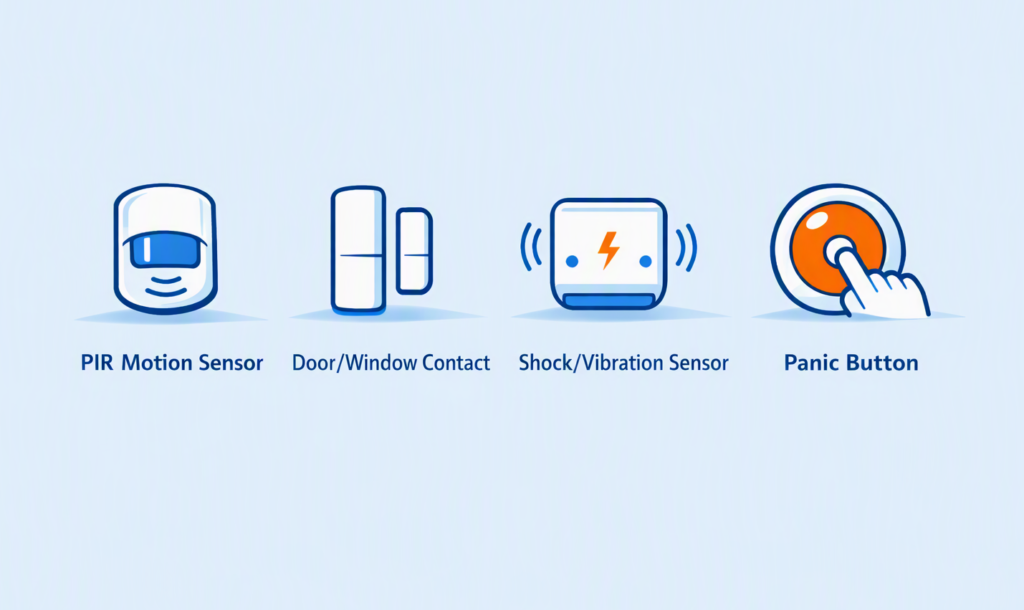
Motion Sensors (PIRs)
Passive infrared sensors detect changes in heat and movement within a room. They are usually most useful in hallways, landings and routes an intruder would need to use.
Door and Window Contact Sensors
These sensors detect when a protected door or window opens. Prioritise external doors and accessible windows, particularly those at ground level or beside a flat roof or extension.
Shock or Vibration Sensors
These are designed to detect an attempt to force or strike a door, window or frame before it opens. They can be helpful on patio doors and other vulnerable entry points but must be adjusted carefully to reduce false alarms.
Panic Alarms
A panic alarm is a fixed button or portable fob that activates an immediate alert. It may be useful for a vulnerable person or someone who wants a quick way to summon help. The action taken after activation depends on the system and monitoring arrangement, so check this in advance. Keep portable devices where they can be reached without being easily triggered by accident.
How Many Sensors You Need
There is no single correct number. Start with the routes and openings an intruder is most likely to use:
- Protect each main external door.
- Consider accessible or hidden windows.
- Use motion sensors on key internal routes such as hallways and stairs.
- Add coverage for rooms containing particularly valuable items if justified.
A small, well-planned system is better than many poorly placed sensors. Avoid adding devices simply because a package contains them. Focus on the routes an intruder would realistically use, not every possible opening.
Where to Place Sensors
- Follow the manufacturer’s height and positioning instructions.
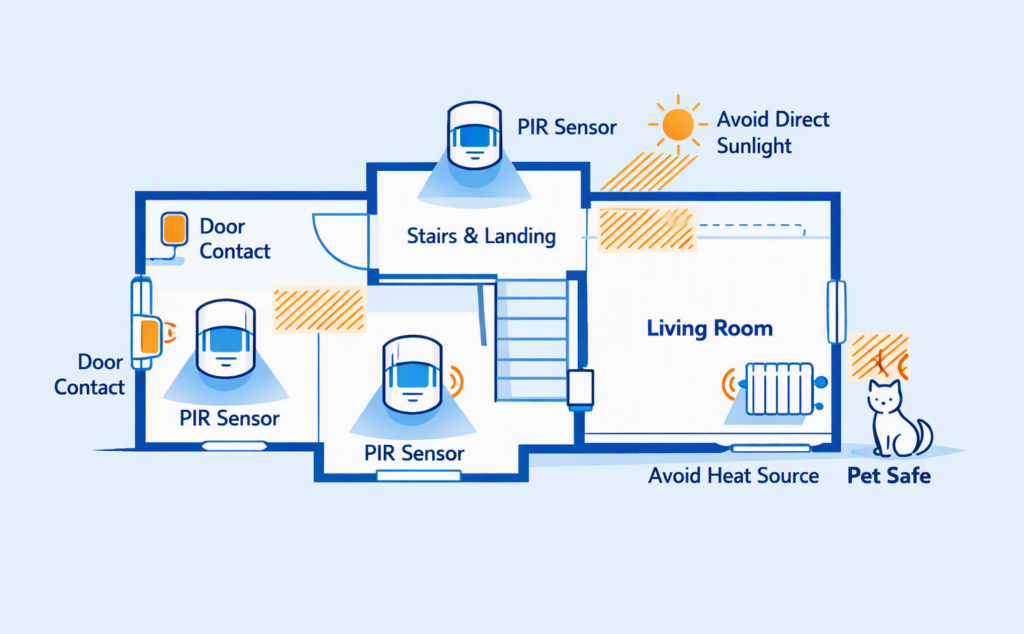
- Keep motion sensors away from direct sunlight, radiators, fires, moving curtains and other sources of rapid heat change.
- Do not aim standard motion sensors at regular pet movement routes; use suitable pet-tolerant models where needed.
- Cover natural choke points such as halls, stairs and landings.
- Prioritise external doors and accessible windows.
- Do not place wireless equipment where thick walls, metal objects or distance may weaken its signal.
How the Different Types Compare
Passive Alarms
- Advantages: simple, affordable and a visible deterrent.
- Points to consider: no external notification or guaranteed response.
Active Alarms
- Advantages: professional monitoring options and greater reassurance.
- Points to consider: higher cost; contracts, response terms and maintenance need checking.
Smart Alarms
- Advantages: flexible, app-based and often DIY-friendly.
- Points to consider: may rely on internet or cloud services; product quality and support vary.
Common Mistakes to Avoid
- Too few sensors: leaving an obvious door, window or route unprotected.
- Poor placement: pointing a motion sensor towards sunlight, heat or moving objects.
- Relying only on motion sensors: contacts can provide an earlier warning at the point of entry.
- Weak physical security: an alarm cannot make up for poor locks, damaged frames or unsecured doors.
- Forgetting to set it: choose a system that is easy enough for everyone in the household to use.
- Ignoring pets: standard sensors may cause repeated false alarms.
- Adding unnecessary features: complexity often leads to confusion and underuse.
- Failing to maintain it: test the system, replace batteries and keep contact details up to date.
- Ignoring false alarms: repeated activations should be investigated rather than accepted as normal.
Maintaining Your Alarm System
A well-maintained alarm is far more reliable than one that is rarely checked. Most systems need only simple, occasional attention, but these small steps make a meaningful difference:
- Test the system regularly. Use the manufacturer’s test mode or follow their instructions to check that sensors, sirens and communication paths are working.
- Replace batteries when prompted. Many faults and false alarms come from low batteries in sensors, keypads or sirens.
- Keep contact details up to date. If alerts go to nominated people or a monitoring centre, make sure numbers and procedures are current.
- Check sensor positions occasionally. Curtains, furniture or decorations can accidentally block or interfere with sensors over time.
- Review app permissions and notifications. Ensure alerts are enabled on all relevant phones and that the app has the access it needs.
- Arrange servicing if required. Professionally installed or monitored systems may include annual checks or maintenance visits.
These small habits help ensure the alarm works when you need it and reduce the chance of unexpected faults or false activations.
Buying Guidance
Choosing an alarm does not need to be complicated. The aim is to match the system to your home, your routines and the level of reassurance you want. The points below will help you narrow down the options before comparing specific products.
Which Type Is Right for You?
A simple way to decide:
- Choose an audible-only alarm if you want a straightforward, affordable deterrent and you live in an area where neighbours are likely to notice a siren.
- Choose a smart alarm if you want app control, flexible installation and the ability to expand the system over time.
- Choose a monitored alarm if your home is often empty, contains higher-value items or you want the reassurance of an external response service.
This decision alone will will make everything simpler and less overwhelming.
Features That Matter
Focus on features that genuinely improve protection or ease of use:
- Reliable sensors suited to your doors, windows and internal routes
- Pet-friendly PIRs if animals move freely inside the home
- A clear keypad or app that everyone in the household can use confidently
- Battery backup and warnings for low battery or communication faults
- Expandable systems so you can add sensors later
- Good installation guidance and accessible customer support
- Transparent information about subscriptions, data use and alert handling
- Competent installation and written maintenance/response terms for professional systems
- A clear, reliable method for receiving alerts (push notifications, SMS, or monitoring centre calls).
These features make the system more dependable and easier to live with.
Features That Sound Useful but Rarely Matter
Some features are often highlighted in marketing but add little practical value:
- Multiple siren tones
- Highly complex automation routines
- Ultra-high sensitivity settings
- Proprietary accessories that limit future expansion
- Overly advanced scheduling or “smart home” integrations you may never use
Common Buying Traps
Avoid choices that lead to frustration or poor performance:
- Buying the cheapest kit and replacing it within a year
- Choosing a system with no expansion options
- Over-sensitising sensors to “catch everything”
- Assuming monitored alarms guarantee a police response
- Buying more sensors than you need
- Ignoring long-term costs such as batteries, cloud fees or monitoring charges
A calm, simple system that covers the likely entry points is usually best.
Price Ranges
- Audible-only alarms are generally the lowest-cost option.
- Smart alarms sit in the middle, though extra sensors and subscriptions can increase the total.
- Professionally installed and monitored systems cost more due to installation, maintenance and ongoing monitoring.
Compare the whole-life cost, not just the box price: equipment, fitting, batteries, servicing, app or cloud fees, monitoring charges and contract length.
When to Spend More
Extra investment may be worthwhile for:
- larger or more complex homes
- properties left empty regularly
- higher-value contents
- isolated locations
- households needing a panic facility
- situations where insurer requirements apply
Only spend where it meaningfully improves reassurance or coverage.
A Clear Buying Checklist
Use this checklist to narrow your choices:
- Which type of alarm suits your home (audible-only, smart, monitored)?
- Which doors, windows and internal routes must be protected?
- Does anyone need pet-friendly sensors or simpler controls?
- Who should receive alerts, and what will they realistically do?
- Will the system still work if broadband or mobile service fails?
- Can you test and maintain the system easily?
- Are all costs clear (equipment, installation, monitoring, cloud fees)?
- Does the brand offer reliable support and replacement parts?
If a system meets these points, it is likely to serve you well.
Next Step: Compare Suitable Systems
See my Top 10 Intruder Alarm Systems →
A curated list of reliable systems for different home types, needs and budgets. Use it as a practical starting point, then check current specifications, ongoing costs, compatibility and support before buying.
Practical rule: choose the simplest system that covers the likely entry points, alerts the right people and will be used consistently.