Safes & Key Boxes — A Practical Guide
Simple advice for choosing, installing and using home safes and key boxes
Quick Start: What You Need to Know in 60 Seconds
- A safe only protects what you actually put inside it, so choose enough space for current and future needs.
- Secure fixing to a solid structure is often more important than the safe’s thickness or rating.
- Fire safes and security safes do different jobs. Choose the protection you need.
- Insurance ratings matter when storing cash, jewellery or other high‑value items.
- For carers or tradespeople, use a key safe independently tested and recognised by Secured by Design.
- Keep the safe out of casual view. An obvious safe attracts attention.
- Never leave a safe key, override key or written code nearby.
What Safes & Key Boxes Are For
A home safe is a secure container for items such as passports, jewellery, important documents, medication and small valuables. It can slow down or deter theft, and some models also protect contents from fire. A safe cannot compensate for poor security habits, and a small unbolted safe may simply be carried away. A safe protects what’s inside it, not the home around it.
A key box stores one or more keys so an authorised person can gain access using a code. It is mainly an access‑control device, not a substitute for a security safe. Typical users include carers, cleaners, trusted neighbours and tradespeople.
A safe is part of your wider security plan — it protects valuables even if other layers like CCTV or alarms are bypassed. Burglars may target a visible safe, especially if it is poorly fixed. Cheap or weak key boxes can also expose the very key that opens your home.
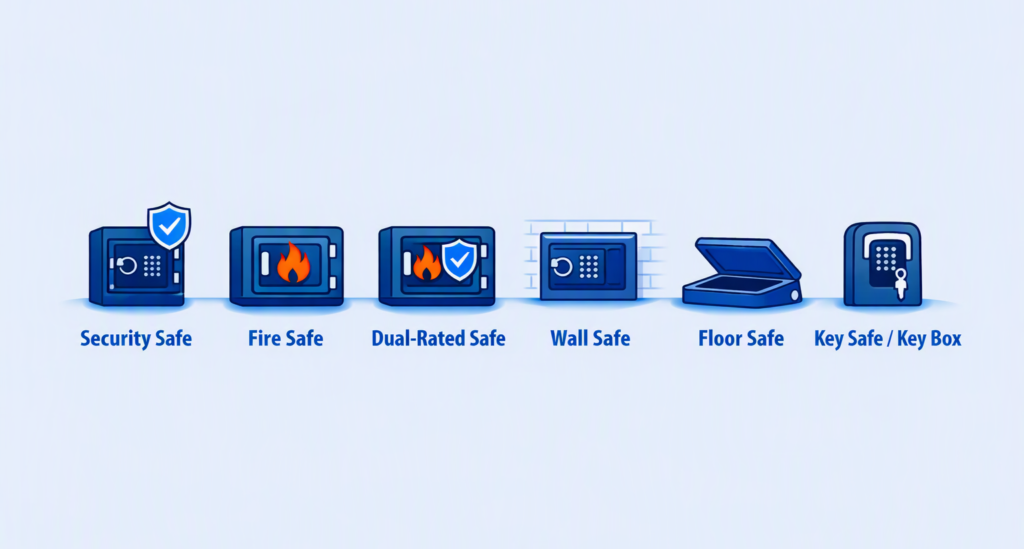
Types of Safes
- Security safes: Designed mainly to resist theft and forced entry.
- Fire safes: Designed to keep contents below a stated temperature for a limited time. Many offer little burglary resistance.
- Dual‑rated safes: Tested for both security and fire protection.
- Wall safes: Built into a wall and concealed, but their protection depends heavily on the wall and installation.
- Floor safes: Fixed into or onto a floor. They can be discreet and difficult to remove when fitted correctly.
- Key safes / key boxes: Hold keys for controlled access rather than protecting valuables.
Important: Fire safes usually protect paper, not digital media, unless the model is specifically rated for items such as memory cards, hard drives or USB devices.
Installation & Positioning
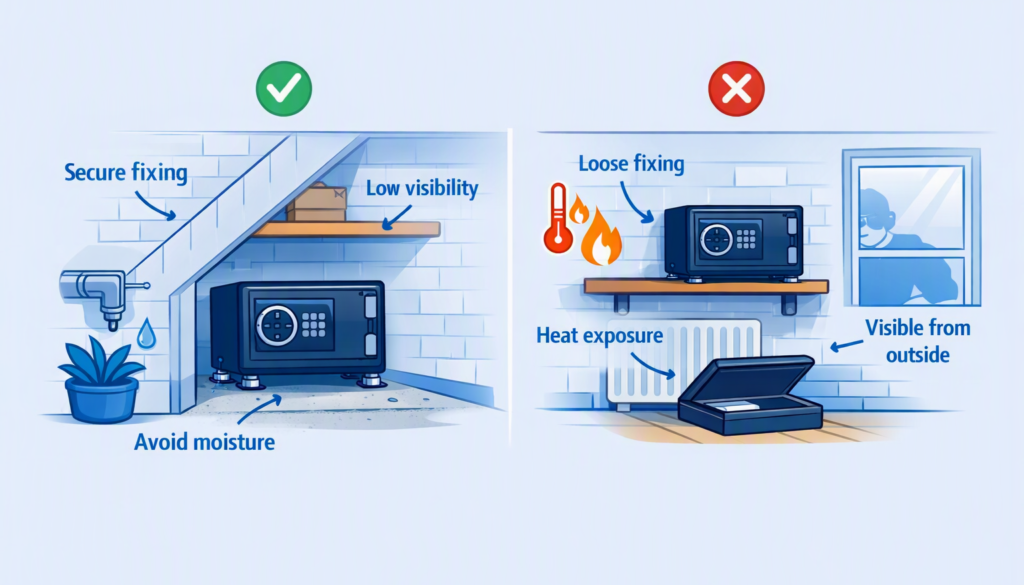
Bolting down is essential. A smaller rated safe securely fixed to the building can be harder to steal than a heavier safe left loose. Follow the manufacturer’s instructions and use every required fixing point.
Fixing Points
- Concrete floor or wall: Usually provides the strongest base when suitable anchors are used.
- Timber floor or stud wall: Fix into structural joists or studs, not only floorboards, plasterboard or thin panels.
- Unknown structure: Use a competent installer rather than guessing what is behind the surface.
Use the manufacturer’s fixings where supplied; generic screws or bolts may not provide the required strength.
Location Selection
Avoid predictable places such as a wardrobe, bedside table or obvious office cupboard. Choose a low‑visibility area that still lets you use the safe easily. Listen for keypad tones and motor noise that could reveal its position.
Concealment Options
Smart alarms use an app for setting, unsetting and receiving notifications. Many can work with compatible cameras or video doorbells and are suitable for flexible or DIY installations.
Environmental Considerations
- Avoid damp areas, direct heat and locations with a high risk of leaks or flooding. Moisture can damage documents, valuables, batteries and lock mechanisms.
- Do not place a safe where it creates a trip hazard or obstructs an escape route.
- Avoid lofts unless the safe is fire‑rated — temperatures can rise quickly in a fire.
Using a Safe Effectively
- Use a code that is hard to guess. Avoid birthdays, addresses or simple sequences.
- Change the code after installation, after sharing it, or whenever access changes.
- Store the safe key and any override key securely, away from the safe.
- Put valuable items away promptly rather than leaving them out for convenience.
- Keep a private inventory, including photographs and identifying details. Store a copy elsewhere.
- Use silica gel packs if moisture may be a problem and replace or recharge them as directed.
- Do not overfill the safe. You should be able to reach items and close the door without forcing it.
- Check batteries and lock operation regularly without leaving the safe open and unattended.
- If your safe has an audit trail feature, enable it when multiple people have access.
Key Boxes: Access Control
Key boxes are useful when a trusted person needs access and no one is available to open the door. Common users include carers, cleaners and tradespeople. If a key box is necessary, choose a model independently tested and recognised by Secured by Design rather than a cheap, unverified product.
- Fix it to sound masonry or another solid structural surface using the manufacturer’s specified fixings.
- Choose a height that is practical for authorised users but does not make the box easy to attack.
- Keep it out of obvious sight where possible, but do not conceal it so completely that legitimate users cannot reach it safely.
- Use a code that cannot be guessed from the address or household. Shield the keypad or dials while entering it.
- Share the code only with people who need it, preferably through a secure direct method.
- Change the code when a user no longer needs access, after contractor visits, or if it may have been seen.
- Never label the key with the address.
- Avoid storing a house key outdoors unless it is genuinely necessary. If the need ends, remove the key or the box.
- Do not rely on a key box as your only method of access control.
- Where a key box is installed, consider including it within your CCTV coverage so access attempts are recorded.
Buying Guidance
Choosing the Right Safe
Size & Internal Layout
List everything you plan to store, then allow extra space for future items. Check the usable internal dimensions rather than the outside size. Shelves, drawers and door mechanisms can reduce capacity.
Security Rating
Look for independent certification rather than relying only on marketing claims.
- EN 14450 (S1, S2) for secure cabinets
- EN 1143‑1 (Grade 0, Grade I) for higher‑security safes
Cash and jewellery ratings indicate typical insurable values, but your insurer may apply different limits or installation conditions. Check before buying
Fire Rating
Check the number of minutes of protection and what material was tested. Paper, digital media and data storage need different temperature limits. A longer rating gives more time, but no safe is fireproof forever.
Lock Type
- Key lock: Simple and reliable, but the key must be kept secure and separate.
- Electronic keypad: Convenient and easy to recode; requires battery checks.
- Dual lock: Requires two methods or two authorised users.
- Biometric: Fast and convenient, but recognition can fail; choose a model with a secure backup.
Build Quality
Look for a strong door and body, protected hinges, anti‑pry edges, secure boltwork and properly designed fixing points. Visible thickness alone does not prove resistance to attack. Metal housings can feel robust, while good‑quality plastic can resist corrosion.
Brand Reliability
Prefer established manufacturers that publish independent test results, provide clear fitting instructions, offer replacement parts and have dependable customer support.
Choosing the Right Key Box
Choose a key box that is strong, weather‑resistant and independently tested.
- Must be independently tested and Secured by Design‑approved.
- Weather‑resistant construction suitable for UK conditions.
- Strong fixing points and supplied fixings.
- Easy‑to‑use code mechanism that works in cold or wet weather.
- Suitable for carers, tradespeople or multiple authorised users.
- Ensure the internal space fits the key size you intend to store.
Additional Buying Factors
- Where the safe will be installed and whether the structure is suitable.
- Whether you need fire protection, theft resistance or both.
- Whether multiple users need access.
- Whether you need audit trail features.
- Whether you need digital media protection.
- Whether you need silent keypad operation.
- Whether the safe must meet insurance conditions.
- Whether the safe or key box will be visible or needs concealment.
Top 10 Safes & Key Boxes
See my Top 10 Safes & Key Boxes list →